Self Portrait in coloured pencil

Showing posts with label primer. Show all posts

Monday, 1 October 2018

Boots the Deerhound 3


 Boots the Deerhound 3

I had a number of visitors last week so the portrait of Boots is not as far along as I would like. At the same time using my pastel pencils is so much fun that when I did manage to sit at my easel I was working with enthusiasm and able to work for longer than I could with the oil paints. 
Remember from my last post that I primed the oil painting with Art Spectrum primer in clear so the painting showed through. I didn’t have to start from scratch. 
I have continued working on his back and side and I am feeling pleased that I am getting a nice soft fur texture that shows the rough coat of a deerhound. Boots isn’t wire haired. I think that would be harder to paint. 
Today I sprayed the work I had done with fixative. I was getting pastel on my hand when I rested it on the surface so I thought I had better do something about it before it got smudged. 
Tomorrow I am going to start on his head. 
I bought some Inktense coloured pencils to embellish the pencil drawings that I am working on to show at the Craft Fair on the 19th and 20th of October. So I added a couple of Faber Castell pastel pencils. I hadn’t tried them before. I was so impressed that I have ordered the whole range of 60 colours. They may arrive tomorrow. 
I am also working on Bentley, and on my pencil drawing of a wolf that I met and fell in love with, when he was 6 months old. I will tell that story after I finish the drawing.

Saturday, 22 September 2018

Boots the Deerhound 2


Boots the Deerhound 2

I have been working a lot on some small pencil drawings of animals, but I got some work done on Boots too. I am enjoying working with pastel and pastel pencils. 
I mentioned in last week’s blog that when I used to paint exclusively in pastel about 20 years ago, pastel pencils weren’t good enough for my technique. But there have been such great innovations in art since then, that I took a chance and bought a full set of Derwent’s pastel pencils and I was very pleased with them. I think that one of the reasons that they are working well on this painting is because of the primer. It is gritty enough to catch the pigment. 
One of the best things about pastel back in the days when I was bringing up my 2 sons, was how you can just walk away and leave it while you deal with the next domestic emergency! Now I am living with dogs and cats I still have domestic emergencies. Moreover, it is so nice just to be able to pick up a pastel or pencil and make marks on the canvas without having to set out my palette and brushes. 
I have been working on the left hand side so I don’t know if the changes in the painting are noticeable. I am happier about the grass and the fluffiness of Boots’ fur against it. I have been blending the darker areas too. It will look more interesting when I have worked on his head. I am getting there. 
I am going to spray it with fixative so I can go over the details with oil paint. So in the end I suppose that I should call it mixed media. 


Sunday, 16 September 2018

Boots the Deerhound


Boots the Deerhound

I used to paint exclusively in pastel until I lost the use of my right hand thumb, which meant that I couldn’t grip a stick of pastel without it dropping on the floor and crumbling. So I changed to working in pencil. I used a grip that meant the weight of the pencil rested on the fork between my thumb and first finger. Then, as my thumb started to get better, I painted in acrylic gouache using a method similar to the egg tempera technique. I lay the colours on the surface without directly mixing or blending them.
Then I tried oil paint. My hand isn’t strong enough to manipulate the paint except in glazes, so I was feeling frustrated. I started to wonder if there was any way of painting pastel over oils. Perhaps I could hold a pastel pencil. When I gave up pastels, the quality of pastel pencils weren’t up to my technique. 
So I started to look around at ways of combining pastel with oils. 

I discovered that there is a binder to turn pigment into oils. I bought a bottle of it but I haven’t tried it yet.
 
Then I found a fixative that claims to fix pastel and other dry mediums so that they can be overpainted in oils. I bought some and tested it. I painted over the blue sky in an unfinished oil painting with Colourfix primer. I have used this primer to use coloured pencils over acrylic and that is a challenge so I knew that I would be able to paint the pastel on top of it. I made a nice blended blue sky and sprayed it with the new fixative. It worked. But I haven’t tried painting over that (yet).

I have been struggling with the painting of Boots. I wasn’t happy with the hedge behind him or with the grass against the shadows of the hedge. So I tried using pastel.

I was thrilled to find that I could use the pastel sticks without dropping them. I was working on the hedge for nearly 2 hours without getting my arm and hand tired. I stopped because it was time to spray it with the fixative. 
What I learned: to spray it lying down and it takes more than a couple of minutes to dry. I set it upright when I first sprayed it and I got a dark green run over the light green grass. I laid it flat and it was easy to wipe clean, but I won’t do that again. It was a good thing that it was only the hedge. 

I brought it downstairs and set it up on the easel and worked on it some more today. I concentrated on improving the grass with pastel. I also worked a bit on Boots’ fur where it curls over the grass. The white is brighter than it was but it still needs work. I added a bit of grey but not enough. 

I am adding 2 photos of materials. First I want to show my “palette”. My brother made it for me by routing grooves in a piece of nice wood. 
Second I use quantities of putty rubber or kneadable erasers; two names for the same thing. I bought 3 different makes because the manufacturers change their formulas sometimes and it is a long time since I bought them. I cut them into small pieces with a pair of scissors. I find that they keep better with a tidy edge, rather than pulling a piece off. The important thing to know about storing putty rubbers is to keep them in the dark. Light makes them turn hard. 
I don’t use them for erasing much. I use them as a blending stump. The kind of stump that I have bought in the past transferred dirt once I had used it once. But a small piece of putty rubber can be squeezed to a new point for days. You can get a really clean edge with it.
The fixative is SpectraFix Degas Fixative. 


Friday, 27 July 2018

Experimenting


Experimenting 

I have been struggling to paint since the Art in the Hills exhibition at Dufton. I had Boots on the easel but I knew that painting his fur needed flowing brushstrokes and I have been finding that my brushes catch on the canvas threads. I needed to find a solution. 
Then I remembered how I painted the portrait of Queen Elizabeth. 
I painted the portrait for the Golden Jubilee. There were celebrations all over the country. Many towns and villages were having street parties but Appleby-in-Westmorland couldn’t do that because the date coincided with the Horse Fair that year and the town would have been too full of visitors. So, instead, the Mayor read out a loyal address from the balcony of the Moot Hall, and I presented the Town with the portrait of the Queen. It is kept in the Mayor’s parlour. (I sent a print of the portrait to the Queen and asked that it would be kept with the loyal address.)
I started the portrait of the Queen in plenty of time. I was working in acrylics on stretched paper. Unfortunately I made a mess of it and the paper buckled so badly that I had to start again. The second version I painted on Graphic Film which is a “dimensionally stable” translucent polyester. As it is translucent I was able to trace the outlines of the portrait to save time, and dimensionally stable means that it stays flat even in humid conditions. 
I was going to paint the whole portrait in acrylics but I was very short of time by the time I got to her bouquet of flowers. I coated the acrylic surface with clear Colourfix primer where the flowers were to go. Colourfix primer has a tooth so I was able to finish the flowers in coloured pencils on top of the acrylic underpainting. It is much faster for me to paint flowers in pencil than with a brush. 


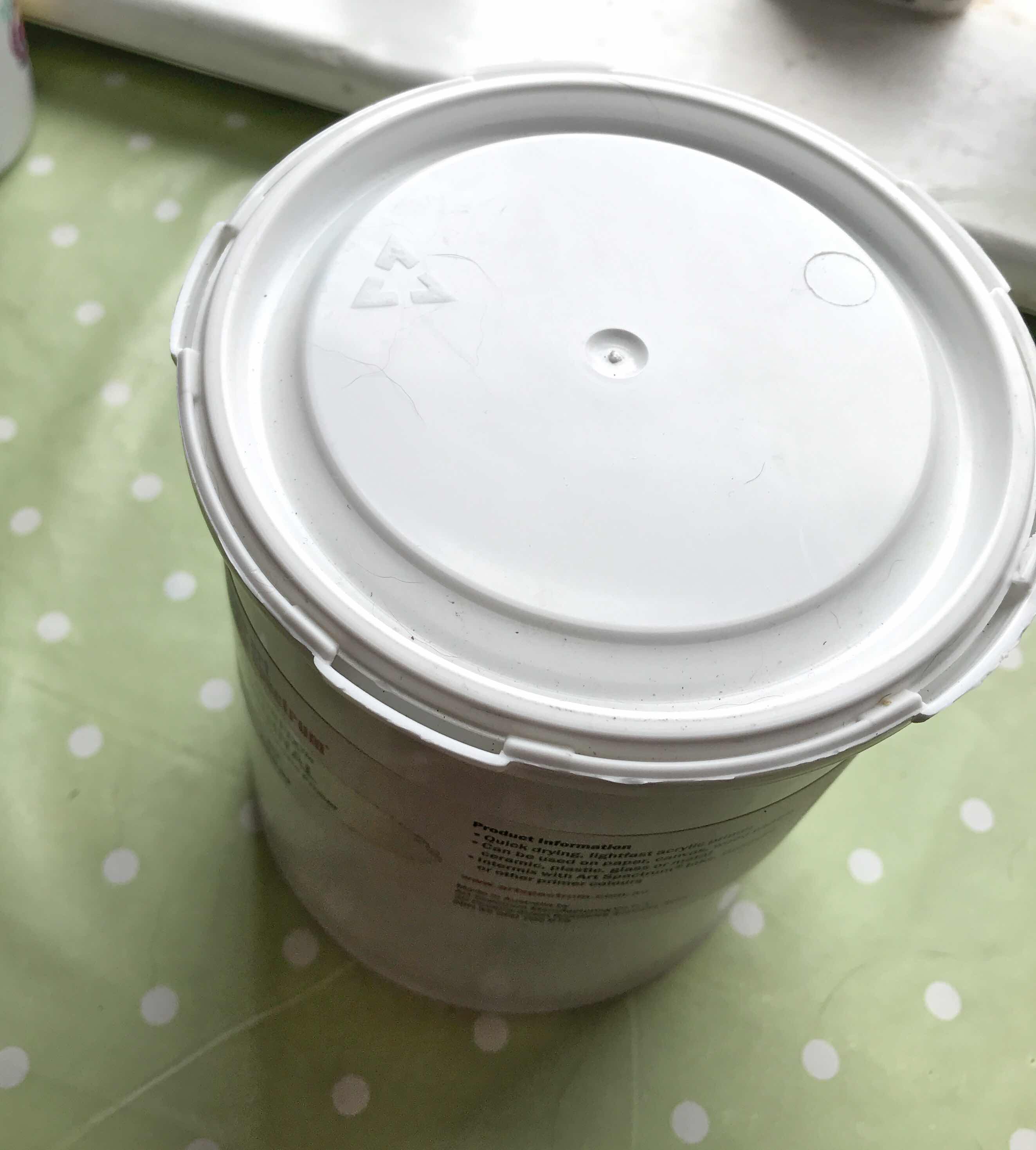
To get back to the portrait of Boots, I bought some Liquitex clear gesso and a big tub of Colourfix primer. I was puzzled about how to open the tub of primer but I had some left from working on the Queen. I painted the gesso over Boots body, and primer over his head so I could compare them. Next day I painted strokes of sepia paint over both areas. Both sides worked and I could make precise strokes of oil paint on them. The Liquitex gesso was smoother, but the instructions say to paint it on a non-oily surface which suggests that it won’t work so well on an oil painting. The Colourfix can be sanded smooth. 
So, in conclusion, I will coat the new canvases in Liquitex gesso but I will paint Colourfix on areas where I have already painted in oils. 
The only problem left is how to open the big tub of Colourfix. I think I know.